Turkey’s steelmakers face pressure

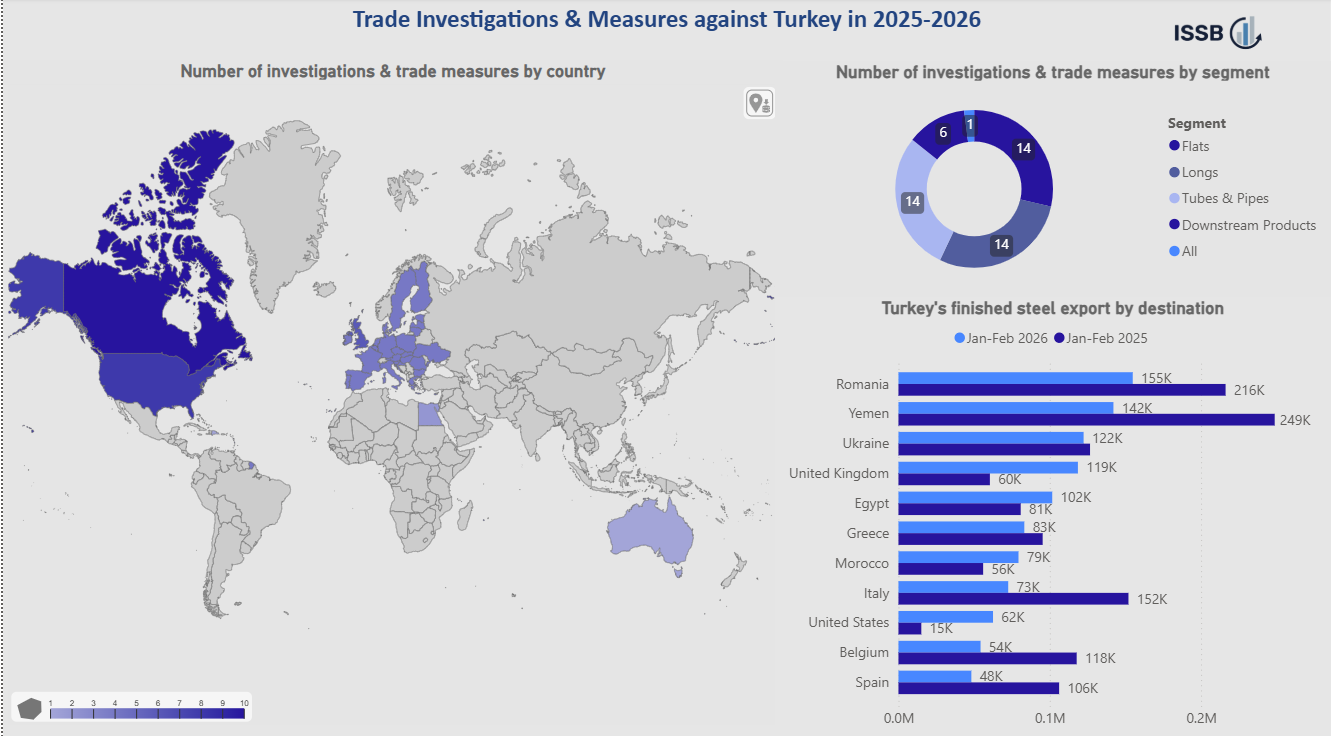
In January–February 2026, Turkey’s finished steel exports have fallen by 14.1% to 2.14 million tonnes (Mt). This decline has been primarily driven by trade measures against Turkey, particularly in European Union countries, and is expected to continue in the coming months, with flat products facing the highest number of trade restrictions.
Exports to Romania dropped sharply from 216 thousand tonnes to 155 thousand tonnes, while shipments to Greece and Italy fell by 12.7% and 52.3%, reaching 83 thousand tonnes and 73 thousand tonnes, respectively. EU buyers substantially replenished their inventories in the second half of 2025, awaiting clarification on CBAM, with the first CBAM price announced on 7 April at €75.36 per tonne of CO₂.
Yemen reduced finished steel imports from Turkey by 42.9% during January-February 2026, to 249 thousand tonnes, while Egypt and Morocco increased imports by 25.8% and 41.7%, respectively. Egypt has concluded its anti-dumping (AD) investigation into cold-rolled and coated steel products from China and Turkey without imposing new duties, as existing safeguard measures are considered sufficient to protect the domestic industry.
Ukraine initiated several investigations into bars, angles, welded pipes, and downstream products in 2025–2026, with import volumes from Turkey showing a 3.4% decline in early 2026.
Shipments to the United Kingdom doubled to 119 thousand tonnes, with the largest increase observed in rebar, rising to 39 thousand tonnes from 16 thousand tonnes in the first two months of 2025. Imports of Turkish galvanised flat products surged from near-zero to 9 thousand tonnes in January-February 2026. In late March, the Trade Remedies Authority (TRA) recommended a country-specific quota for Turkey, as category 4 steel imports from the country exceeded the threshold during the Period of Investigation.
The United States continued ramping up imports from Turkey despite numerous trade measures and investigation, seeing a rise from 15 thousand tonnes in the first two month of 2025 to 60 thousand tonnes during the same period this year. Local hot-rolled coil price in the US market surpassed $900/s.t in late 2025 and $1000/s.t in March 2026.